
You might not have noticed this before, but your Panasonic remote has two little holes in it. Until something funky happens with your air conditioner.
There are two buttons, one labeled RC and the other labeled AC. One is labeled RC, and the other is labeled AC. Know these buttons before things get worse. This isn’t a single reset function. They are two different actions.
Understanding the Two Reset Buttons
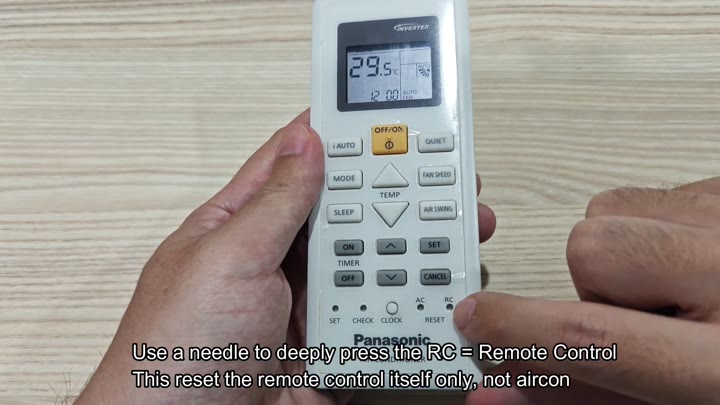
And that’s how to fix remote glitches: Pressing this first button resets only the remote itself by poking thin needle into the RC hole. Nothing happens in the air conditioner unit.
Before pressing the button, your remote screen may say “auto fan” is turned on and shows a temperature of 29.5 degrees Celsius. After pressing the RC reset, any strange inputs on the remote will be cleared, but the machine won’t reboot.
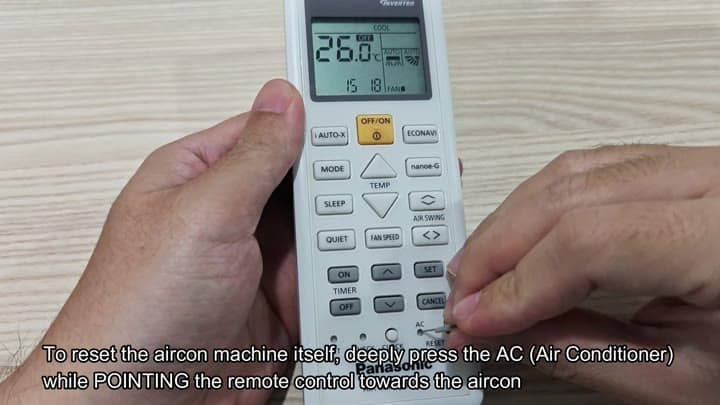
Just the controller get reset.
Next up is the second button. This button is called AC or Air Conditioner. When you hit this button you want to point the remote at indoor unit.
With your thumb, firmly push on the AC reset point on the remote while holding the remote in one hand. While this happens, it may show 26.0 degrees on the display (if it’s in cool mode). The trick here is that the remote has to sends a signal to the wall unit.
The AC button will reset the unit and the RC button will reset the remote.
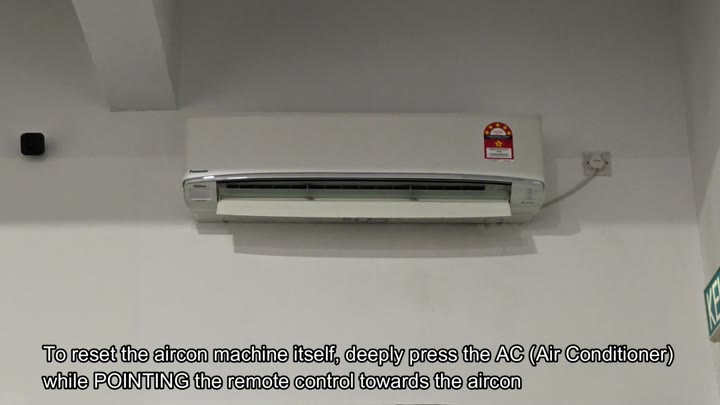
Point the remote straight at the white air conditioner mounted to the wall. There’s a sticker on the corner of the aircon that has the energy rating. Pointing straight at that thing, you press the AC reset button.
That resets the air con itself. It is not just the remote. So that actualy reboots the entire system.
If your earlier troubleshooting steps didn’t work, maybe you only reset the remote? Maybe you didn’t realize there was an AC button to try as well?
This is a common mistake.
When you think of the two as distinct, this makes more sense. The RC reset is convenient; it resolves any glitch in the remote. The AC reset is hardware related; it resets the system logic.
Both times you do it with a needle. A pen tip will also work. Something that’s narrow and pointy. You apply pressure each time (but not really hard). Apply just enough pressure so there is a click.
Turns out that resetting your AC also brings your air conditioner back to life, and now maybe your remote works too. Resetting the remote doesn’t help; it’s usually a problem with how your unit communicate.
Maybe at first you push the wrong button, wasting time before figuring out what is different than before. But then you get it right quick. Having two buttons means there are two purposes, which makes it easy.
You do not need any tools besides a needle, any settings menu, or an app. No need to reset anything in software.
The act of resetting is simpler than you think. Resetting may mean unplug everything… But not always. It’s right there, but it’s so easy to overlook. You can miss it for years.
So now you know what to do: you hit RC in case the remote acts up; you hit AC in case the unit itself act up.
And you point the remote at the air conditioner unit. Not the first one. Because it’s important to keep your remotes apart. Otherwise the unit and remote communication gets messed up.
And there’s more: It stops the guesswork. It fixes the problem easy. It lets you see a clear winner.
And yes, it’s worth it. That’s how it’s done. Which is so much better than before. So much easier. It wasn’t like that before. It annoyed you. It didn’t make sense. It made a huge difference. A classic mistake. But you fixed it.
The needle is little, fits in your toolbox, and you keep it there for a reason. Better late then never.
It’s good to check, you should of done so sooner but the reset buttons worked out well and now everything is running just fine. You learned something new. That’s a win.
Now don’t dismiss those buttons! They’re there for a reason. Most folks miss little holes in things like this. Well, Panasonic put them there for a good reason, and you were no different.
But now you are. There are simple answers out there; you just need to see them. And you did, and you found the answer.